Google I/O 2026: From Chatbot to Agent OS, How Gemini Reinvents Itself with Antigravity, Spark and Omni
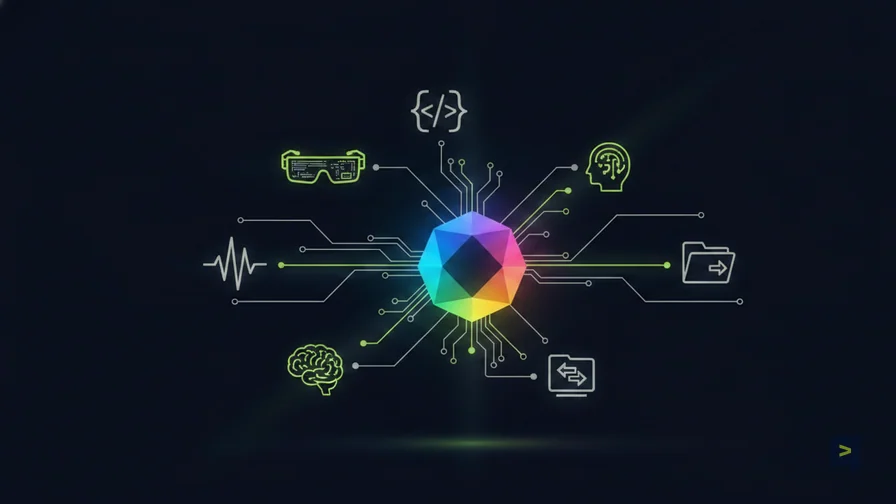
Google I/O 2026 closed with a clear message: the next generation of Gemini stops being a chatbot and becomes a cross-surface agentic layer that goes from the code editor to the desktop OS, from the browser to smart glasses, and now also into the science lab. Five announcements concentrate that shift.
Antigravity 2.0: agentic coding as a desktop application
Google DeepMind introduced Antigravity 2.0, a leap from the original IDE into a multi-surface suite: standalone desktop application, command-line interface, SDK so third-party software can plug into its AI, and enterprise support. Google describes it as a mission control where several agents work in parallel on the same project, with managed execution and native integration with Gemini 3.5 Flash, with up to a 12x jump in response speed within the platform.
The package is paired with the Build with Gemini XPRIZE hackathon, with 2 million dollars in prizes. The competitive read is direct: Antigravity steps onto the same ground as Cursor, GitHub Copilot, Claude Code and Codex, with the same goal of pushing developers toward supervision and architecture work.
The short-term signal is not just competition, it’s speed: the Gemini 3.5 Flash jump is what turns the platform into something usable daily, not into a keynote demo.
Gemini Spark lands on the desktop
Google’s 24/7 personal agent, Gemini Spark, is rolling into the Gemini macOS app. Built on Gemini 3.5 Flash and powered by the Antigravity platform, it enables local tasks like organizing user files, extracting data from PDFs directly into Google Sheets, and voice-controlled reformatting and moving text between apps with no typing.
The rollout comes with a Gemini Live redesign that now opens inside the app, with improved speech-to-text and automatic clean-up of filler words and repetitions. Spark will reach trusted testers first and then Ultra users in the U.S., with support for MCPs and connectors (Canva, OpenTable and Instacart among the first).
The strategic read: Google moves agentic logic from mobile into the operating system, terrain where Copilot on Windows and Apple Intelligence on macOS want to make a difference. By choosing macOS as the entry door to the desktop, Google goes head-on against the Mac professional user before the Windows enterprise one. Still pending: what percentage of tasks Spark will resolve without supervision, how it will handle permissions on personal data, and when it will roll out beyond the U.S. and the Ultra plan.
Gemini Omni: conversational video editing
For creation, Google announced Gemini Omni, integrated into Google Flow and Flow Music. The proposal is not to compete in pure generation against models like Seedance 2.0, but to open a new lane: conversational video editing in the style of Nano Banana for image. The idea is that the user describes changes and the model applies them on existing clips, rather than generating from scratch.
It’s a coherent move with the I/O thesis: when the agent is the default interface, the natural editor flow also goes through conversation.
Gemini in smart glasses
Google previewed its entry into smart glasses with Gemini integrated, with a launch planned for this fall. The first product will be audio-only glasses with no screen, oriented to hands-free assistance, accompanied by deals with Samsung, Gentle Monster and Warby Parker to manufacture and distribute different designs.
The strategy splits two lanes: an entry device focused on voice and audio, and more polished models in partnership with fashion and eyewear brands. It’s the same playbook Meta followed with Ray-Ban and EssilorLuxottica, and positions Google against a potential OpenAI hardware with Jony Ive and against the integration of Apple Intelligence into Apple devices.
The fashion-brand alliance model substitutes, for now, a strong proprietary wearable. International rollout beyond the U.S. is still without a calendar.
Gemini for Science: the agent walks into the lab
Google DeepMind introduced Gemini for Science, an experimental suite developed with Google Research, Google Labs and Google Cloud. It covers three fronts:
- Academic literature analysis and synthesis with NotebookLM.
- Hypothesis generation and evaluation with Co-Scientist, which runs a multi-agent tournament where several models propose, debate and discard hypotheses with reasoning traceability.
- Agentic computational discovery with a prototype on AlphaEvolve that generates and scores thousands of code variants in parallel, with epidemiology as the reference use case.
It’s a subtler move than the previous ones, but potentially deeper. Bringing agents with traceability into scientific research means fighting for a vertical where Anthropic (with Claude and its biology work) and OpenAI (with its recent push on deep research) are already positioned.
The underlying thesis: Gemini is no longer a chatbot
Putting the five announcements together, the direction is clear. Gemini stops being a chat box and becomes a distributed agentic layer:
- Antigravity covers development.
- Spark covers personal productivity on the desktop.
- Omni covers video creation.
- The glasses cover the physical layer.
- Gemini for Science covers specialized verticals.
The open question, which several analysts have been flagging, is internal coherence: while OpenAI and Anthropic converge chat and code environments into a single experience, Google multiplies surfaces (Studio, Gemini, Antigravity) without it being obvious which one should win inside its own catalog. The upside, if Google executes well, is huge. So is the risk: that users and developers get lost between brands.
For teams building with generative AI, I/O 2026 leaves three practical work lines: review the agentic coding stack before locking in long-term decisions, evaluate Spark when it’s available in Europe, and start thinking about the conversational interface as a default front-end, not an alternative modality.
Want to talk about how this affects your team?
At My Tech Plan we help companies bring generative AI into their day-to-day, from model selection to deploying agents in production. If after reading this I/O recap you’re wondering how your organization fits into this shift, let’s talk.